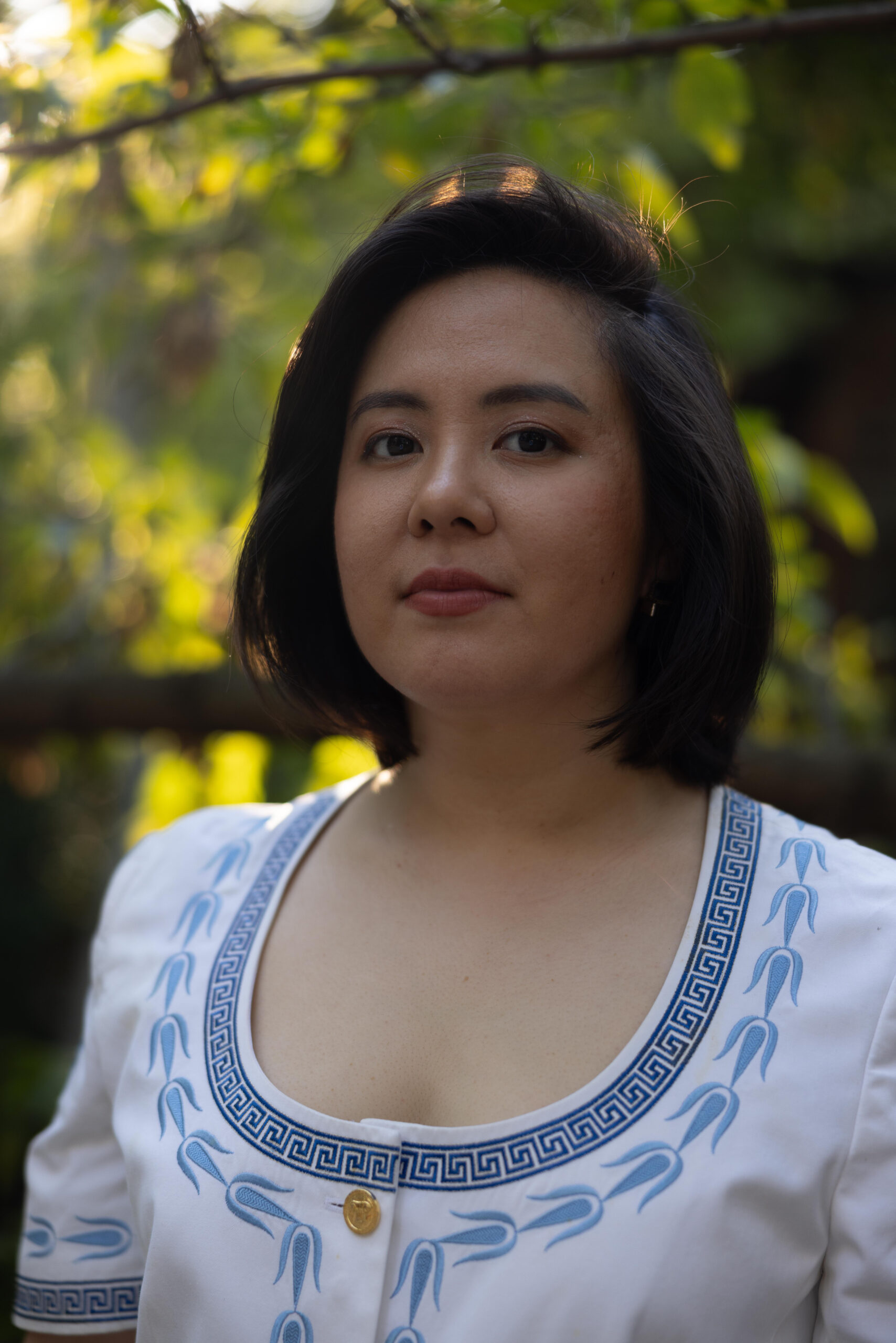
Interviewee: Anna Fam-Rieskaniemi, director, Entropy (Entropia)
Interviewer: Eric Nong, Viet Film Fest Artistic Director
To what extent is Entropy indicative of the tensions you have personally felt between Polish and Vietnamese culture? Is it partially biographical?
I grew up between Polish and Vietnamese cultures, so navigating between two cultures resonates with me. Entropy is not autobiographical, but the emotions behind it are personal. After the screenings, I was surprised by how many people, including those without an immigrant background, recognized themselves in the characters. They connected with the expectations of parents, the need to find your own path, and the tension between what we want for ourselves and what our families expect from us. That was very meaningful to me because it showed that a story rooted in a specific cultural experience can still be emotionally universal.
I also wanted to show both sides of this tension, not only the younger generation but also the parents, whose expectations often come from love and care, even when they can lead to conflict.
I’m glad Entropy can contribute, even in a small way, to a broader representation of Vietnamese characters in Polish cinema, as people whose heritage is an important part of who they are, but not the entirety of their identity.
What is the status of Vietnamese or, more broadly, Asian representation in Polish media? And what is being done to address any shortcomings in such representation?
When I decided to make Entropy, I felt that the representation of Vietnamese people in Polish media was still too limited. There had been films about the Vietnamese community in Poland, but to me, they often felt like variations of the same narrative, centered on immigration and the experience of being an outsider trying to adapt to a new society.
I wanted to shift that perspective. I wanted to portray Vietnamese people not simply as immigrants, but as an integral part of Polish society. For me, the more interesting tensions are not necessarily about adapting to a new country. They can exist much closer to home, within families, between generations, and in places where it can be much harder to articulate what we actually feel.
I think representation can evolve not only by telling more stories about minorities, but by allowing those characters to exist with the same complexity as anyone else, with conflicts, desires and identities that are not defined solely by their ethnicity.
What was the collaborative process like with your cinematographer, Maciej Kwaśniewski, especially in terms of scenes at night?
Thank you for this question. Maciej was not only the cinematographer of Entropy. We had already been collaborating several years earlier, when we created the pre-visualization of a key scene that ultimately helped us secure the grant for the film. So by the time we started shooting, we had already gone through many phases together, from the initial euphoria to the much more practical realities of making the film.
The night scenes, or scenes that had to appear as night, were definitely our biggest challenge. Creating Entropy taught both of us how to build a world intentionally from the elements we had. We learned to work with limitations rather than let them define the film. I think we both feel that after this experience, we are ready for a feature, because we know we will find a solution.
We established our color palette before shooting, and black was particularly important to us. We also thought carefully about the dominant colors in each scene and the colors surrounding each character. We wanted Entropy to feel like a complete cinematic work, not simply a short film made within limitations. We wanted to make the best version of the film we were capable of making at that moment.
Of course, things can always happen differently than planned on a set. But I believe those moments shape us most as filmmakers, because they test whether you can make a decision and take responsibility for it.
Working with Maciej is one of those creative collaborations that stays with you. We are now preparing to make our feature debut together.
Why did you make the world of classical music as the backdrop to the drama found within your film?
I went to music school myself, so for much of my childhood I was navigating not only between two cultures, but between two schools as well. That experience also made choosing classical music as the world of Entropy a very conscious directing decision.
I wanted it to be a space beyond culture and language, something that could connect people from different backgrounds. That felt particularly relevant to Mây, who is constantly navigating between different cultural worlds.
There is also something meaningful about music in this context. In Poland, Chopin’s music is deeply connected to the country’s cultural identity and often associated with longing for one’s homeland, while music education is also highly valued in many Vietnamese families. So music became a shared space between these worlds, without belonging entirely to either of them.
I enjoy bringing together references from different cultural layers and letting them coexist without everything needing to be explained. For Mây, music is also her own passion and ambition, and a language for emotions that are difficult to articulate in words.
How did you cast Aleksandra Duong as the protagonist, Mây, and Viet Anh Do as Hoang?
Hoang was actually found before the full script was finished, so Viet Anh became part of the process quite early. From our first script reading, he was very engaged, and what really stood out to me was his ability to stay present and carry emotion even when he wasn’t speaking. There isn’t a lot of dialogue in Entropy. For me, the most important things often happen in the situations between the characters, in their reactions and in what remains unspoken. I needed actors who could communicate all of that without having to explain it.
Mây was a very different journey. I knew it was going to be a demanding role. Aleksandra had never acted in front of a camera before, so in many ways we both had to take a leap of faith. I had to trust her, and she had to trust me and herself. That trust became a very important part of how we worked together.
Aleksandra stood out during the casting because she could really listen and stay present, taking in what was happening and letting it affect her without immediately showing us everything. She had her own process, and I was interested in that from the beginning.
Even now, the process of making this film remains a very personal experience that we share.
We have seen a modest, but notable increase of films from Eastern Europe that have been submitted and accepted to Viet Film Fest over the last five years. What aspects of the Vietnamese diaspora in Eastern Europe, and Poland in particular, do you think distinguishes them from elsewhere in the world?
That’s a very interesting perspective. In fact, I’ve been thinking about this in relation to the title of the film itself. Entropy is not named after Mây, because the story is not only about her. I was thinking about social entropy, about what happens when cultures meet, influence one another and inevitably change in the process.
Wherever we go, we bring part of ourselves with us: our culture, our habits, our ways of seeing the world. But the place we arrive in inevitably shapes us too, whether we intend it to or not. I think that process is happening everywhere, not only within the Vietnamese diaspora in Poland, and there is something beautiful and unique about the way it happens in each place.
I’ve had the chance to visit a few places in Europe and meet Vietnamese communities there, and I could already see both similarities and differences. You can sometimes recognize a shared sense of community almost immediately, but every country has its own temperament, history and social context. The emotional experiences may be very similar, while the way people express them can be completely different, shaped by all these other elements that enter the mix.
Maybe what distinguishes the diaspora in Eastern Europe is precisely this particular mix of histories, cultures and generations, rather than one single characteristic shared by everyone. I’m very curious to see how that mix looks here in the Vietnamese American community, and I’m really looking forward to getting to know it through the festival and its audience.
What do you want audiences to take away from Entropy?
I didn’t make Entropy to give people one particular message. I wanted to create a spark for connection, conversation, or even disagreement, not only between generations or across cultures. For me, it’s not about offering solutions. I believe art is about experience and discovery, and about creating meaning together through that meeting. That could be between parents and children, partners, friends, or even people who see the world very differently. If the film makes someone want to talk, listen, or understand another person a little better, that would mean a lot to me.
I treasure every screening and Q&A I’ve had in different countries, but one of the most memorable moments was being in a room where everyone had a different feeling about the characters and their decisions. I was the happiest because I realized that this was exactly what I had hoped for: people were debating, disagreeing, and seeing the same story in completely different ways. That was when I thought: my job is done.
Entropy will be shown in two in-person screenings during Viet Film Fest 2026 at the Frida Cinema in Santa Ana, California. Entropy is part of the “Practice Makes Imperfect” short film set on Thursday, October 8 at 10 PM. It is also part of the Best Short Film Nominees set on Saturday, October 10 at 9 AM.
Entropy will be shown in the virtual edition of “Practice Makes Imperfect” during VFF At Home (Monday, October 12-Sunday, October 25). The film will only be available for those viewing the set in California.