Interviewee: Phuong Mai Nguyen, director, In Waves
Interviewer: Eric Nong, Viet Film Fest Artistic Director
How did you first come about AJ Dungo’s graphic novel, and what about it motivated you to adapt it into a film?
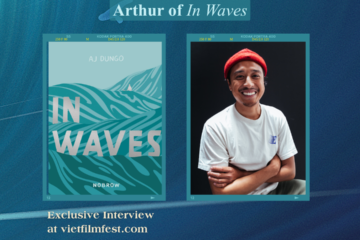
I ran into In Waves, the graphic novel, like any random reader and finished reading it in tears. I didn’t expect a book about surfing would provoke anything like this because I wasn’t really a fan of surfing and the ocean always scares me. However, AJ [Dungo] depicted it as a way to overcome his grief and surfing taught him how to be resilient. And this kind of puts a lot of words on feelings that I’ve been through and helps me to understand my own grief.
So when Priscilla Bertin, my producer, came to me and said that she was looking for a director to adapt the book into an animated feature, I was very happy to come on board the project as this story means a lot to me, and I was sure that there is something deeply universal in AJ and Kristen’s story that a lot of people would connect to.
Honestly, I was so frightened to sign for something that is also a very intimate story and relies on a true story. I wanted to make sure of how AJ feels about this adaptation, so we met right at the beginning of the process. I showed the images and the script to him and he was very open to every change that we made in the adaptation.
Can you elaborate on how you achieved your visual style for most of the film, as well as its scenes explaining surfing’s Hawaiian origins?
For me, AJ’s graphic novel has something very unique in its style, the way he depicts water,the waves, and even a pattern of wood fascinates me. However, as I started drawing, I felt like this style is very difficult to be animated. And that for a film, we need something visually more immersive. For the staging, I wanted to play with different framings, but also different colors to fully feel the Californian lighting and weather. So that’s why I decided to go for something more colorful, and to play with the textures of the waves rather than a pattern.
As we were in the writing process, Fanny Burdino and Samuel Doux, the scriptwriters, also suggested that the character of AJ is doing an informal art school through his drawings. And, through his drawings, he finds his way to express his emotions. The small historical sequences depicting Hawai’i are a metaphor regarding AJ’s feelings and unconsciousness. I felt that AJ’s drawing was quite close to wooden engraving, therefore telling a story of the ancient time in his style also feels to be the right choice.
How familiar were you with Southern Californian skateboarding and surfing culture before making this film? And how did you integrate what you learned into the film?
I wasn’t familiar at all with Southern Californian skateboarding and surfing culture! I went surfing once in France before working on the film, and it was a total failure.
But after that I had the opportunity to go visit AJ in Southern California and he brought me to all his skating and surfing spots so that I could get some references, pictures, and videos. I tried surfing again, but I am still very bad at it. But the fun thing is I kind of put my own fear of the ocean into the film, as there are scenes where AJ learns how to overcome his fear of the waves and learn how to surf.
I also understand that surfing is all about accepting the unpredictable nature of the waves. We can tell a metaphor of life through surfing: it’s a lot of patience, waiting for the right waves to come, it’s a lot of paddling and falling before catching the right waves, to fully experience the sensational glide on the waves. And being in the ocean makes us feel very small in nature.
When we learn what happens to Kristen, how did you steer your film’s tone to ensure that it was never patronizing or othering Kristen’s situation?
Portraying Kristen in her illness was one of my big concerns, because this is about a story of real people, and I had a sentiment that we need to preserve her image, to ensure that she would be remembered as a radiant person, and through a vision of her dying. So I tried to remain very restrained in the scenes involving the hospital, medical care, and farewells. These are extremely sensitive moments, which can be more difficult to bear in the film, due to movement and duration. This way to treat her illness seemed important in order to respect both Kristen’s memory and the viewer.
Independent European animation is more dependent on utilizing the talents of several small- and medium-sized studios across a nation or across the EU (compared to major American or Japanese animation where there is one studio that dominates production). All one has to do is look at the credits to films such as Flow (2024) and Little Amélie or the Character of Rain (2025) to see how many studios are involved in independent European animated films. What challenges or opportunities does this pose for a film like In Waves?
Making a film in different small studios across France was quite a challenge to deal with, mainly because there are so many problems in communications. It’s mostly about giving feedback that could be fully understood while we’re talking about technical and artistic problems. Also, when you jump from one studio to another, they don’t have the history of all the production problems. So each time we speak with another studio, we have to re-explain the whole process, train the artists to our pipeline and software.
But on the other hand, you can get funding from different areas and regions so it helps a production to get their budget. If I could, I would want a production to take place in the same place to make sure that everyone can communicate easilier.
Other than AJ Dungo’s graphic novel, did any other films or other pieces of art influence your approach to In Waves?
When I started drawing for In Waves, I got a lot of inspiration from paintings, especially David Hockney and Raymond Pettibon’s work.
I love Hockney’s work because I love the Californian lighting that he depicted. His work is very colorful but also there is something very lonely and melancholic in the characters that he portrayed. So I thought this is exactly the feeling that I need for In Waves.
Raymond Pettibon is an artist who did several paintings about surfing, and AJ mentioned him as one of his major influences. So I checked out his work and it helped me find a way to create the look of the waves in the film, trying to capture the movement, the sense of speed and shining water with brush strokes.
I also had so many films and TV series in my mind, speaking about influences, such as Mid90s by Jonah Hill for the skateboarding scenes and the TV series Sex Education for the teenage vibe.
Your short film, Chez moi, remains the only animated film to win an award at VFF (Trống Đồng Award for Best Short Film for VFF 2016). How have you grown as a filmmaker and as a person since then?
It’s a hard question! I have never asked myself this question. As a filmmaker, I’m just glad to be able to finish my first feature. I don’t even think this was possible. Also making an adaptation is quite different to making a film that you write. It’s more responsibility but you kind of have also a little distance to the story and the characters. Making a feature involves more people and also financial questions, it felt like being in a big boat and every decision made needed to be thought twice. And as a person, I still have to figure out what’s the purpose of a life, I guess!
In Waves will screen as part of the VFF Encore on Friday, October 23 at 7 PM at the Frida Cinema in Santa Ana, California. It will not be shown virtually.