Interviewees: Duc Ngo Ngoc and Duc Thi-Bui, director and co-writer, Made In Germany
Interviewer: Katy Nguyen, Programming Intern
Would you say living in Germany or speaking German influences one’s personality a certain way for the Vietnamese diaspora?
Duc Ngo Ngoc: For us, the second generation of the Vietnamese diaspora in Germany, German is often the language we feel most comfortable with and the one in which we can express ourselves most precisely. For the first generation, Vietnamese is often still the main language.
This can create a very particular mix of Vietnamese and German, a language that is sometimes only fully understood by Viet-Germans who grew up in Germany. Language therefore has a strong influence on our identity and can also raise the question of where we actually belong: Are we German or Vietnamese? Or both? These questions of language, identity, and belonging are central themes in Made in Germany.
For us, as German filmmakers with Vietnamese heritage, it is also about finding a way to communicate across generations and beyond language barriers. And film is our way of doing that.
What made you decide to write a story and relationship between a father and daughter as opposed to a mother and daughter?
Duc-Thi Bui: From the very beginning, we wanted to tell a story about a father and daughter whose relationship is rather distant and who both find it difficult to talk openly about their feelings. On one side, there is a father who follows traditional Vietnamese values, and, on the other, a daughter who enjoys her freedom and wants to test boundaries.
This is exactly where different ideas and expectations clash and conflicts arise. Especially in a father-daughter relationship, these conflicts are also shaped by patriarchal structures and certain expectations of how a daughter is supposed to be and behave.
We love both characters, and they love each other, too. But that love is not necessarily expressed in words or shown openly. Precisely because their world and their relationship are not so easy to explain, we found it interesting to make these unspoken codes visible through small gestures and behaviors in the film.
Your film has incredible performances from both father and daughter. What was your criteria or thought process when casting them?
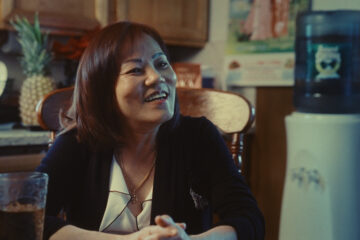
Duc Ngo Ngoc: For me as a director, it was important to cast someone as Ani who truly knows this reality and is half-Vietnamese and half-German herself. There are still very few roles in film and television for people with this background. With Maria Mai Rohmann, we found almost exactly the person we had written. It was her very first film role, but her authenticity, style, and attitude were there from the beginning.
I already knew Đang Ngọc Long, who plays the father Trung, from my film Apples and Oranges, which won Best Short Film at Viet Film Fest in 2018. He brings exactly the combination we were looking for in Trung: a certain coolness and restraint, but also an emotionality and vulnerability that lies beneath the surface.
You have a history of working with non-professional actors. How do they elevate your storytelling?
Duc Ngo Ngoc: Since I come from documentary filmmaking, I love working with non-professional actors. Putting people into an emotional situation that they don’t just act, but can actually feel, has a special power for me. It’s something I learned from documentary filmmaking and try to bring into my fictional work as well.
I like to take a hybrid approach to directing and work with real experiences and emotions. Many situations in the film are very close to my own experiences. For example, I experienced the scene at the government office almost exactly like that myself. Because of this, I understand the emotions of the characters very well and can bring those experiences into my work with the actors.
Comedy is an element in your film. What are your thoughts on employing humor as a way to further a character’s development and the overall story?
Duc-Thi Bui: Dramaturgically, humor, when used well, is one of the best tools you can have. Through comedy, we get closer to the characters and can more easily see the world from their perspective.
For me, it is important to always take the characters seriously. The humor doesn’t come from making fun of them, but from situations where different expectations and perspectives collide.
I use humor a bit like an ingredient in cooking: a little bit of everything, but never too much. Humor, seriousness, coolness, strictness, intimacy, and emotion – when the balance is right, that’s a good recipe for me.
As her father’s interpreter, Ani has to be the liaison between him and the German world. Why is it important to highlight the role of the interpreter or translator?
Duc Ngo Ngoc: I often had to translate and mediate for my parents myself. The scene at the government office is also based on a situation that happened in a very similar way to me and my family.
I often experienced that people who don’t speak German well are quickly perceived as less intelligent by authorities. At the same time, officials use complicated bureaucratic language that even native speakers don’t always understand. That’s why the first generation often brings their children along to translate and help communicate their concerns.
The second generation often grows into this role automatically, even though they may not want to take it on. This is a reality for many Viet-German families, and exactly the dynamic I wanted to show in the film.
At one point, a family relative confronts the father and remarks that he’s “become so German”. This quote serves as a reminder of the expansive diasporic experience, that it is not limited to young adults. If you were to overhear this statement, what would you say to either the father or the relative?
Duc-Thi Bui: I think I’ve heard this phrase so many times that I don’t really respond to it anymore. It can be very exhausting to have the same discussion over and over again.
The second generation can’t help being socialized in a country that is not their parents’ homeland. Of course, values will change, and there should also be room for new traditions and identities to develop. For me, integration only works when it comes from both sides. You don’t have to give up one part of yourself in order to be part of the other.
This appears to be a pilot, is it too soon to ask how many episodes you want this series to be? Will this be available outside of Germany? Did you always want to make a show?
Duc Ngo Ngoc: Made in Germany is not a pilot, but an anthology series that was released in Germany in 2025. In each of the six episodes, we enter a different world. Ani, Jamila, Cumba, Nikki, Mo, and Zehra are all in their early twenties and were born in Germany. The central question is: What does it mean to be “made in Germany” when you don’t look like what many people imagine a “typical German” to look like? Six episodes, six stories.
The series was successful in Germany, and we hope it will also be seen internationally. For Thi and me, it was our first project together, and for me it was an exciting experience working in a series format. Now we are focusing on cinema again.
Next year, we will shoot our feature film Ha-Neu Berlin, which won the German Screenplay Award in 2025 (one of Germany’s highest film honors, the Golden Lola). We were the first Viet-Germans ever to receive this award. Especially at a time when we are seeing a noticeable shift to the right around the world, we believe it is important to tell diverse stories and make our community more visible. The film is planned for a nationwide theatrical release in Germany and hopefully, in a few years, it will also make its way to Viet Film Fest.
Made in Germany will screen at the Frida Cinema in Santa Ana, California on Thursday, October 8th, at 10:30 PM. It will not be shown virtually.